
• HOME PAGE
  • ABOUT JMD
  • CONTACT JMD
  • ONLINE VIRTUAL SERVICES
  • Publications

J. Michael Dennis ll.l., ll.m. Live

~ ~ JMD Live Online Business Consulting ~ a division of King Global Earth and Environmental Sciences Corporation

J. Michael Dennis ll.l., ll.m.  Live

Tag Archives: ai

How AI Changes Leadership Responsibility

20 Friday Mar 2026

Posted by JMD Live Online Business Consulting in Artificial Intelligence, The Future of AI

≈ Leave a comment

Tags

ai, AI Governance Design, AI Governance Gap, AI Responsability Shift

Artificial intelligence is typically framed as a technological disruption. Leaders are told to move fast, adopt tools, and “not fall behind.” What is discussed far less, yet matters far more, is how AI fundamentally reshapes leadership responsibility itself.

This is not a marginal shift. It is structural.

The introduction of AI into an organization does not simply add capability; it redistributes agency. Decisions that were once clearly human become hybrid. Accountability becomes diffused. Judgment is partially delegated to systems that operate probabilistically, not deterministically. In that environment, leadership is no longer about directing work: it is about governing systems of decision-making.

This is precisely where most organizations are unprepared.


The Responsibility Shift: From Execution to Interpretation

Traditional leadership models assume that systems execute and humans decide. AI disrupts that boundary.

Large Language Models, predictive systems, and optimization engines do not “understand” in the human sense, they generate outputs based on statistical patterns. Yet those outputs increasingly influence strategic, operational, and even ethical decisions.

This creates a critical asymmetry:

  • AI produces recommendations without accountability
  • Leaders retain accountability without full visibility into reasoning

The result is a widening responsibility gap.

Leaders are now responsible not only for outcomes, but for:

  • The validity of AI-generated outputs
  • The conditions under which those outputs were produced
  • The risks embedded in probabilistic reasoning
  • The organizational decisions influenced by those outputs

This is not a technical issue. It is a governance issue.


The Illusion of Capability

A central problem is that AI systems appear more capable than they are.

They generate fluent language, structured analysis, and confident recommendations. This creates a narrative of competence that can mislead decision-makers into over-trusting outputs.

In reality:

  • AI systems generate language, not understanding
  • They simulate reasoning, rather than perform grounded reasoning
  • They lack situational awareness, accountability, and intent

When leadership treats AI outputs as authoritative rather than interpretive, decision quality degrades, often subtly, and over time.

This is where leadership responsibility intensifies: leaders must actively interpret AI, not passively consume it.


The Governance Gap

Most organizations approach AI adoption through a capability lens:

  • What tools should we deploy?
  • How can we increase efficiency?
  • Where can we automate?

Very few ask the more critical questions:

  • Who is accountable when AI influences a decision?
  • What level of confidence is required before acting on AI outputs?
  • How do we distinguish between augmentation and substitution?
  • What decisions must remain irreducibly human?

Without clear answers, organizations drift into what can be called implicit delegation: AI begins to shape decisions without explicit authorization or oversight.

This is not innovation: it is unmanaged risk.


What I Do as an AI Foresight Strategic Advisor

As an AI Foresight Strategic Advisor, my role is not to promote AI adoption. It is to clarify the implications of AI on leadership, decision-making, and organizational integrity.

Concretely, I operate across three domains:

1. Strategic Interpretation

I help leaders understand what AI systems actually do, and just as importantly, what they do not do.

This includes:

  • Deconstructing AI capabilities versus narratives
  • Identifying where AI adds value versus where it introduces distortion
  • Clarifying the limits of model outputs in real-world decision contexts

The objective is to replace hype with operational clarity.


2. Responsibility Mapping

AI changes who is responsible for what, but most organizations never explicitly redefine those responsibilities.

I work with leadership teams to:

  • Map decision flows involving AI systems
  • Identify points of implicit delegation
  • Reassign accountability where ambiguity exists
  • Define escalation and override mechanisms

This ensures that responsibility remains intentional, not accidental.


3. Governance Design

AI requires a new layer of governance, not compliance theatre, but decision architecture.

This involves:

  • Establishing protocols for AI-assisted decision-making
  • Defining acceptable risk thresholds
  • Creating validation and challenge mechanisms
  • Embedding human judgment where it is non-negotiable

The goal is not to slow down innovation, but to ensure that it remains aligned with organizational purpose and accountability.


Leadership in the Age of AI: A Different Discipline

AI does not eliminate leadership: It makes it more demanding.

Leaders must now:

  • Operate under conditions of simulated certainty
  • Make decisions influenced by systems they do not fully control
  • Maintain accountability across hybrid human-machine processes
  • Resist the pressure to equate fluency with accuracy

This requires a shift from decision authority to decision stewardship.

The leaders who will navigate this effectively are not those who adopt AI the fastest, but those who understand its limitations the most clearly.


The Strategic Reality

The real risk is not that AI will replace leaders.

The risk is that leaders will unknowingly outsource judgment while remaining accountable for the consequences.

That is an untenable position.

AI is not just a technological transition: It is a redefinition of responsibility. Organizations that fail to recognize this will not fail because they lack tools. They will fail because they misunderstood what leadership required in the first place.


Final Thought

Very few talk about how AI changes leadership responsibility because it is uncomfortable.

It forces a recognition that:

  • Control is more limited than it appears
  • Understanding is more fragile than assumed
  • Accountability cannot be delegated, even when decision-making is

That is the space I work in.

Not where AI is impressive, but where its implications are consequential.

J. Michael Dennis ll.l., ll.m.

AI Foresight Strategic Advisor

Based in Kingston, Ontario, Canada, J. Michael Dennis is a former barrister and solicitor, a Crisis & Reputation Management Expert, a Public Affairs & Corporate Communications Specialist, a Warrior for Common Sense and Free Speech. Today, J. Michael Dennis help executives and professionals understand, evaluate, and responsibly deploy AI without hype, technical overload, or strategic blindness.


Contact

jmdlive@jmichaeldennis.live

Share this:

  • Share on X (Opens in new window) X
  • Share on Facebook (Opens in new window) Facebook
Like Loading...

Anthropic’s Claude: Capabilities, Military Use, and Strategic Controversies

07 Saturday Mar 2026

Posted by JMD Live Online Business Consulting in AI News, General

≈ Leave a comment

Tags

ai, Anthropic"s Claude, Artificial Intelligence, Claude Military Applications, Technology

Claude is a family of large language models (LLMs) developed by the U.S.-based AI company Anthropic. Originally designed as a general-purpose generative AI, with broad capabilities in natural language understanding and generation, Claude has also become deeply embedded in national security and defense workflows through government contracts and classified integrations.

Technical Capabilities Relevant to Defense

As an advanced LLM, Claude’s core competencies include:

  • Large-Scale Data Processing: Claude can analyze and synthesize massive amounts of unstructured text, such as intelligence reports, intercepted communications, and strategic documents, far faster than human analysts.
  • Pattern Recognition & Trend Extraction: The model excels at identifying patterns and correlations across datasets, aiding threat detection and predictive analytics.
  • · Operational Simulation & Planning Support: Claude can be used to model strategic scenarios and evaluate possible outcomes under different assumptions, a capability prized in simulations and war-gaming.
  • · Cybersecurity Analysis: Specialized government-focused versions of Claude (e.g., Claude Gov) enhance analytics on cybersecurity threats.

To support classified defense audiences, Anthropic developed Claude Gov models, which are tailored for use in secure environments (e.g., AWS Impact Level 6 networks) where they handle sensitive or classified materials.

Actual and Reported Military Use Cases

Although direct evidence about specific military operations is often classified, multiple credible reports indicate Claude has already been used in defense contexts:

  • Intelligence and Decision Support: Claude has been integrated through third-party defense platforms such as Palantir, enabling analysts to process classified data and provide actionable summaries and insights.
  • Strategic & Operational Planning: U.S. defense agencies reportedly use Claude for scenario modeling, risk assessments, and planning support in time-sensitive situations.
  • Classified Operations: According to media reports, Claude was used in at least one classified U.S. military operation (e.g., operations in Venezuela), although precise details of its role remain disputed and the company’s usage policies prohibit direct application to violence or weapons control.

Ethical Guardrails and Usage Policies

Anthropic’s internal policies explicitly restrict certain types of applications for Claude:

  • No Fully Autonomous Weapons: Claude cannot, by company policy, make lethal force decisions or autonomously guide weapons without human oversight.
  • No Mass Domestic Surveillance: Anthropic refuses to allow Claude to be used for bulk monitoring or tracking of civilians within the United States.
  • Restrictions on Direct Violence and Weaponization: The usage policy forbids Claude from being used to design weapons or provide instructions for violent acts.

These safeguards are rooted in Anthropic’s commitment to “Constitutional AI” principles, a framework meant to align powerful models with ethical, legal, and safety considerations.

The Pentagon Dispute and Policy Clash

Despite Claude’s utility in defense workflows, tensions between Anthropic and the U.S. Department of Defense (DoD) have escalated sharply:

  • Contract and Requirements Conflict: The DoD has insisted that any vendor supplying AI under defense contracts must agree to allow their models to be used for “all lawful purposes,” which in practice could include weaponization, surveillance, and other sensitive applications. Anthropic has resisted removing its guardrails.
  • Supply-Chain Risk Designation: In February, March 2026, senior Pentagon officials reportedly labeled Anthropic a “supply chain risk” and President Trump ordered federal agencies to phase out Anthropic’s AI tools (including Claude) over security concerns.
  • Defense Production Act Threats: Defense leaders threatened to use statutory authorities to compel Anthropic to loosen its safety policies or risk losing contracts.

Anthropic’s leadership, while supportive of defense work, including intelligence analysis and cybersecurity support, has defended its limits as necessary for maintaining democratic norms and preventing dangerous misuse.

Capabilities vs. Limitations in Military Contexts

It’s important to distinguish Claude’s analytical empowerment from autonomous warfighting:

Strengths

  • Rapid synthesis of complex tactical and strategic information.
  • Enhanced intelligence-analysis throughput.
  • Assistance in planning, modeling, and decision support.
  • Adaption to classified workflows with enhanced security controls.

Limitations

  • Claude is not a perception and control system for autonomous physical systems (e.g., drones or missiles) in current defense roles. LLMs lack the real-time sensor integration and control fidelity required for kinetic systems.
  • Ethical policies and company restrictions preclude Claude from direct lethal action without human oversight.

Broader Implications for Military AI Governance

The Anthropic-DoD standoff highlights a broader debate in military AI:

  • Ethical Guardrails vs. Operational Flexibility: Should private firms impose strict ethical limits on how their AI is used — even by democratic governments, or should national security imperatives override those limits?
  • Human-in-the-Loop Requirements: Ensuring machines do not substitute critical human judgment in life-or-death scenarios remains a key policy concern.
  • Global Arms Competition: As other nations pursue AI-enabled warfare, the balance between safety and capability becomes a strategic consideration for democratic states.

Conclusion

Anthropic’s Claude demonstrates that LLMs are now at the forefront of modern defense intelligence and planning. Its deployment in classified defense workflows underscores the military’s appetite for AI-driven decision support. However, Claude’s integration into military systems has surfaced a fundamental conflict between ethical safeguards imposed by a private AI developer and government demands for comprehensive operational capability.

This clash, over autonomous weapons, mass surveillance, and contractual access, is now a defining case in how 21st-century militaries will govern and regulate artificial intelligence in practice.

J. Michael Dennis ll.l., ll.m.

AI Foresight Strategic Advisor

Based in Kingston, Ontario, Canada, J. Michael Dennis is a former barrister and solicitor, a Crisis & Reputation Management Expert, a Public Affairs & Corporate Communications Specialist, a Warrior for Common Sense and Free Speech. Today, J. Michael Dennis help executives and professionals understand, evaluate, and responsibly deploy AI without hype, technical overload, or strategic blindness.

Contact

jmdlive@jmichaeldennis.live

Share this:

  • Share on X (Opens in new window) X
  • Share on Facebook (Opens in new window) Facebook
Like Loading...

AI Reality Brief for Leaders

07 Saturday Mar 2026

Posted by JMD Live Online Business Consulting in General

≈ Leave a comment

Tags

ai, AI Compliance, AI Confusion, AI Governance, AI Reality, AI Strategic Clarity, Artificial Intelligence, Business, Technology

AI Reality Brief for Leaders

A Strategic Guide to Making AI Decisions Without Hype

Artificial intelligence has moved from research labs into boardrooms at extraordinary speed. Since the public release of systems such as OpenAI’s ChatGPT, Anthropic Claude and large-scale models from Google and Microsoft, executive pressure to “do something with AI” has intensified across every sector.

Yet beneath the enthusiasm lies a persistent strategic risk: leaders are being asked to make consequential capital, governance, and reputational decisions in an environment saturated with marketing claims, vendor exaggeration, and incomplete understanding.

This brief is designed to help leaders separate signal from noise. It does not argue for or against AI adoption. It establishes a disciplined framework for making AI decisions grounded in capability, constraint, risk, and measurable value.


1. The Current AI Landscape: Capability vs. Narrative

AI discourse currently oscillates between two extremes:

  • Inevitable transformation of all industries
  • Existential threat narratives
  • Productivity miracles with minimal integration cost

None of these narratives is operationally useful.

In practical terms, modern AI systems, particularly large language models and multimodal foundation models, are:

Strong at:

  • Pattern recognition at scale
  • Probabilistic text and content generation
  • Classification and summarization
  • Code assistance and automation of structured cognitive tasks
  • Augmenting knowledge workers

Weak at:

  • Causal reasoning
  • Accountability
  • Reliable long-term planning
  • High-stakes decision autonomy
  • Contextual judgment beyond training distributions

Leaders must evaluate AI systems as statistical engines, not as strategic agents.

The most expensive AI mistakes today are not technical failures: they are governance failures driven by misinterpretation of capability.


2. The Five Strategic Questions Before Any AI Investment

Before approving pilots, budgets, or enterprise integrations, leadership teams should formally answer five questions.

1. What Problem Are We Actually Solving?

AI should never be the starting point. Operational friction, cost inefficiency, risk exposure, or revenue stagnation should be.

If the problem cannot be precisely defined in business terms (cost, margin, time, risk, throughput), AI will not clarify it.

2. Is the Task Deterministic or Probabilistic?

AI performs best where tolerance for probabilistic output exists.

  • Drafting assistance → acceptable variance
  • Compliance decisions → low tolerance for variance

Misalignment here produces reputational and regulatory exposure.

3. What Data Governance Controls Exist?

AI systems amplify data conditions.

  • Poor data hygiene → scaled error
  • Unclear ownership → legal exposure
  • Cross-border data flow → regulatory risk

Without robust governance, AI increases operational fragility rather than resilience.

4. What Is the Integration Cost?

Vendor pricing is rarely the dominant cost driver.

Hidden costs include:

  • Workflow redesign
  • Change management
  • Legal review
  • Cybersecurity reinforcement
  • Staff retraining
  • Vendor dependency risk

True ROI must incorporate integration complexity, not just license fees.

5. Who Is Accountable?

AI cannot be accountable. Executives remain responsible.

Clear lines of responsibility must exist for:

  • Model oversight
  • Output validation
  • Escalation procedures
  • Incident response

Ambiguity in governance is a material board-level risk.


3. The AI Adoption Maturity Curve

Organizations typically move through four stages:

Stage 1 — Experimentation

Isolated pilots, informal use by employees, enthusiasm-driven testing.

Risk: Shadow AI, unmanaged data exposure.

Stage 2 — Tactical Integration

AI embedded in specific functions (marketing automation, customer service chatbots, coding assistance).

Risk: Fragmented strategy; tool proliferation.

Stage 3 — Strategic Alignment

Executive-level oversight; AI initiatives tied to KPIs and risk frameworks.

Risk: Overextension before governance maturity.

Stage 4 — Structural Integration

AI integrated into operational architecture with compliance, security, and accountability embedded.

Reality: Few organizations have genuinely reached this stage.

Most companies overestimate their maturity by at least one stage.


4. Where AI Delivers Real Enterprise Value

Across sectors, AI delivers measurable value in four domains:

1. Cognitive Throughput Expansion

Increasing output per knowledge worker without linear headcount growth.

2. Decision Support

Enhancing, not replacing, human judgment with predictive analytics and scenario modeling.

3. Operational Efficiency

Automating repetitive classification, routing, documentation, and monitoring tasks.

4. Risk Detection

Fraud detection, anomaly identification, compliance scanning.

What AI does notreliably deliver is autonomous strategic judgment.

Boards should treat AI as infrastructure augmentation, not leadership substitution.


5. The Governance Imperative

Regulatory scrutiny is increasing globally, including structured frameworks such as the European Union AI Act. Regardless of geography, the direction is clear:

  • Documentation requirements will increase
  • Transparency expectations will rise
  • Liability boundaries will tighten

Leaders should proactively establish:

  • AI risk committees or subcommittees
  • Model inventory and audit trails
  • Acceptable use policies
  • Vendor risk assessments
  • Incident response protocols

Governance is not a brake on innovation; it is a prerequisite for sustainable AI deployment.


6. Common Strategic Errors

Error 1: Confusing Demonstrations with Deployment

A compelling demo is not operational reliability.

Error 2: Over-Reliance on Vendor Narratives

Vendors optimize for growth. Executives must optimize for durability.

Error 3: Treating AI as a Cost-Cutting Tool Only

Pure cost reduction strategies underutilize AI’s potential in augmentation and innovation.

Error 4: Delegating AI Entirely to IT

AI is not merely a technical initiative. It is a strategic transformation issue involving operations, legal, HR, finance, and the board.


7. A Disciplined AI Decision Framework

For every proposed AI initiative, require:

  1. A written problem definition
  2. Quantified expected value
  3. Defined risk exposure
  4. Governance assignment
  5. Exit criteria if performance fails

This converts AI from enthusiasm-driven adoption to capital-disciplined investment.


8. The Executive Mindset Shift

Leaders do not need to become machine learning engineers.

They must become:

  • Fluent in probabilistic system behavior
  • Skeptical of anthropomorphic language
  • Structured in risk evaluation
  • Relentless in value measurement

AI is neither magic nor menace. It is an accelerating computational capability layer that amplifies both strengths and weaknesses of organizational structure.


Conclusion: Strategic Clarity Over Hype

The defining AI advantage will not belong to the earliest adopters.
It will belong to the most disciplined adopters.

Executives who:

  • Separate capability from narrative
  • Align AI with defined business objectives
  • Install governance before scale
  • Preserve human accountability

Will capture durable advantage.

Those who chase hype will accumulate technical debt, governance exposure, and strategic confusion.

The AI era does not require faster decisions.
It requires better ones.

Strategic clarity is now the differentiator.

J. Michael Dennis ll.l., ll.m.

Based in Kingston, Ontario, Canada, J. Michael Dennis is a former barrister and solicitor, a Crisis & Reputation Management Expert, a Public Affairs & Corporate Communications Specialist, a Warrior for Common Sense and Free Speech. Today, J. Michael Dennis help executives and professionals understand, evaluate, and responsibly deploy AI without hype, technical overload, or strategic blindness.

Contact

jmdlive@jmichaeldennis.live

Share this:

  • Share on X (Opens in new window) X
  • Share on Facebook (Opens in new window) Facebook
Like Loading...

The AI Reality Gap

06 Friday Mar 2026

Posted by JMD Live Online Business Consulting in Artificial Intelligence, The Future of AI

≈ Leave a comment

Tags

ai, AI Reality Gap, Artificial Intelligence, Large Language Models, Narrative Hype

Artificial intelligence has become the defining technological conversation of the decade. In boardrooms, policy circles, and media discourse, AI is often described as a transformative intelligence capable of reasoning, understanding, and autonomously reshaping industries. Yet beneath this narrative lies a growing structural tension: a widening gap between what AI systems can actually do and what they are widely believed to do.

This gap—the AI Reality Gap—is not merely a matter of technical misunderstanding. It is a strategic problem. When the narrative surrounding a technology diverges significantly from its operational reality, decision-makers begin to plan around mythology rather than capability. For executives, boards, and institutions attempting to navigate the current wave of AI adoption, understanding this distinction is becoming a critical leadership skill.


Language Generation Is Not Understanding

At the center of the current AI wave are Large Language Models (LLMs). These systems are extraordinarily effective at generating coherent, contextually appropriate language. They can draft reports, summarize documents, answer questions, and simulate conversation with impressive fluency.

However, fluency should not be confused with understanding.

LLMs operate by identifying statistical patterns across vast corpora of human-produced text. During training, the system learns which words are likely to follow others within particular contexts. When prompted, it generates responses by predicting the next most probable sequence of tokens based on those learned patterns.

This process produces outputs that often appear intelligent. But the system itself does not possess comprehension, intent, or conceptual awareness. It does not know whether a statement is true, whether a strategy is feasible, or whether a recommendation is safe. It is producing language structures that resemble human reasoning without performing reasoning in the human sense.

The distinction matters.

Human cognition operates through grounded understanding—linking language to experience, causality, and intention. Language models, by contrast, operate through statistical correlation. They simulate the surface patterns of knowledge without possessing the underlying semantic framework that humans rely upon when making judgments.

When public discourse describes these systems as “thinking,” “reasoning,” or “understanding,” it introduces a conceptual distortion. The metaphor becomes mistaken for the mechanism.


Narrative Hype Distorts Executive Decision-Making

Technological hype is not new. Every major technological wave—from the early internet to blockchain—has been accompanied by exaggerated narratives about its near-term capabilities.

What distinguishes the current AI moment is the speed and scale with which these narratives propagate.

AI demonstrations are inherently persuasive because they produce immediate, visible outputs. A model generating a detailed business plan or a convincing paragraph appears to demonstrate intelligence directly. For non-technical observers, the leap from “convincing language” to “machine reasoning” can feel natural.

Media coverage amplifies this perception. Headlines frequently frame AI developments in anthropomorphic terms—machines that “think,” “learn,” or “replace human expertise.” Venture capital narratives, startup marketing, and technology evangelism reinforce the same framing because it increases perceived market potential.

The result is a feedback loop:

Impressive outputs → amplified narrative → inflated expectations → accelerated investment.

Within this environment, executives face intense pressure to “do something with AI.” Boards demand AI strategies, investors reward AI narratives, and competitors publicly announce AI initiatives.

Yet when strategic decisions are made under conditions of narrative inflation, organizations risk confusing symbolic adoption with functional value. Leaders may pursue AI initiatives not because the technology meaningfully solves a problem, but because the absence of such initiatives appears strategically negligent.

This dynamic turns AI from a tool into a signaling mechanism.


Investing in Perception Rather Than Capability

When narrative overtakes reality, capital allocation begins to drift.

Organizations may invest heavily in AI infrastructure, platforms, and pilot projects without first establishing where the technology actually delivers measurable advantage. Internal teams are asked to “apply AI” broadly rather than to solve narrowly defined operational problems.

This often leads to predictable outcomes:

  • Pilot projects that demonstrate novelty but fail to scale operationally
  • Automation initiatives that underestimate the role of human judgment
  • Overestimation of reliability in systems that remain probabilistic and error-prone
  • Strategic initiatives driven by technological prestige rather than business necessity

In many cases, AI deployments work best when they are tightly scoped—assisting with document synthesis, pattern recognition, workflow support, or data summarization. These applications can generate real value.

But they are far from the sweeping narratives of autonomous decision-making or generalized machine reasoning that dominate public conversation.

When organizations invest based on perception rather than capability, they encounter a familiar pattern: initial enthusiasm followed by disillusionment. The gap between expectations and outcomes becomes visible only after significant resources have already been committed.

This cycle is the operational manifestation of the AI Reality Gap.


The Strategic Imperative for Leaders

For executives and boards, the challenge is not to dismiss AI, but to interpret it correctly.

Artificial intelligence—particularly language models—represents a powerful computational capability. Properly deployed, it can accelerate knowledge work, support analysis, and enhance productivity across many domains. But its power lies in augmentation, not autonomous cognition.

Strategic clarity therefore begins with a simple discipline: separating technological capability from technological mythology.

Leaders who succeed in the AI era will be those who ask precise questions:

  • What specific task is the system performing?
  • What data does it rely upon?
  • What failure modes exist?
  • Where must human judgment remain in the loop?
  • How does this technology create measurable operational advantage?

Organizations that treat AI as an engineering capability rather than a cultural phenomenon will allocate resources more effectively and avoid the cyclical hype dynamics that accompany every technological wave.


Closing the AI Reality Gap

The widening gap between AI narrative and AI capability is not inevitable. It is a consequence of how societies interpret complex technologies through simplified stories.

Closing this gap requires a more disciplined form of technological literacy—one that acknowledges both the genuine potential and the structural limitations of current systems.

AI can generate language with extraordinary sophistication. It can analyze patterns at scales no human team could match. It can assist in the production and organization of knowledge.

But it does not understand the world in the way humans do.

For leaders navigating the present technological landscape, recognizing this distinction is not a philosophical exercise. It is a strategic necessity.

The organizations that thrive in the coming decade will not be those that believe the most ambitious AI narratives.

They will be those that understand where the narrative ends—and where the technology actually begins.

J. Michael Dennis ll.l., ll.m.

Based in Kingston, Ontario, Canada, J. Michael Dennis is a former barrister and solicitor, a Crisis & Reputation Management Expert, a Public Affairs & Corporate Communications Specialist, a Warrior for Common Sense and Free Speech. Today, J. Michael Dennis help executives and professionals understand, evaluate, and responsibly deploy AI without hype, technical overload, or strategic blindness.

Contact

jmdlive@jmichaeldennis.live

Share this:

  • Share on X (Opens in new window) X
  • Share on Facebook (Opens in new window) Facebook
Like Loading...

AI Realism, Governance, and Strategic Clarity

12 Thursday Feb 2026

Posted by JMD Live Online Business Consulting in The Future of AI

≈ Leave a comment

Tags

ai, Artificial Intelligence, Business, Technology

As artificial intelligence moves from experimentation to infrastructure, three disciplines must advance together: realism, governance, and strategic clarity. Without this triad, organizations risk either overhyping AI’s promise or underestimating its systemic consequences.

AI Realism

AI realism begins with an unsentimental view of what current systems can and cannot do. Today’s AI excels at pattern recognition, probabilistic reasoning, and scale, but it does not possess understanding, intent, or accountability. Treating AI as an autonomous decision-maker rather than a powerful tool leads to brittle systems and misplaced trust. Realism demands rigorous evaluation, clear use cases, measurable outcomes, and an honest accounting of failure modes, bias, drift, and operational costs. It also means rejecting both techno-utopianism and fear-driven paralysis.

Governance

Governance provides the guardrails that realism alone cannot. Effective AI governance is not a compliance checkbox; it is a continuous capability. It aligns legal, ethical, technical, and operational oversight across the AI lifecycle, from data sourcing and model development to deployment and monitoring. Good governance defines who is accountable when systems err, how risks are escalated, and when human judgment must override automated outputs. Crucially, governance must be adaptive: static rules cannot keep pace with fast-evolving models, data, and deployment contexts.

Strategic Clarity

Strategic clarity connects AI efforts to organizational purpose. Too many initiatives fail because they start with technology rather than strategy. Strategic clarity answers hard questions upfront: What problems truly matter? Where does AI create durable advantage versus short-term efficiency? Which capabilities should be built in-house, partnered, or outsourced? Clear strategy prevents fragmentation, dozens of pilots with no path to scale, and ensures AI investments reinforce long-term goals rather than distract from them.

Together, these elements form a coherent operating model. Realism grounds expectations, governance manages risk and responsibility, and strategic clarity directs effort and capital. Organizations that integrate all three will not only deploy AI more safely and effectively, they will make better decisions about where AI belongs, how it should be used, and when it should not be used at all. In the AI era, discipline is the real differentiator.

J. Michael Dennis ll.l., ll.m.

Based in Kingston, Ontario, Canada, J. Michael Dennis is a former barrister and solicitor, a Crisis & Reputation Management Expert, a Public Affairs & Corporate Communications Specialist, a Warrior for Common Sense and Free Speech. Today, J. Michael Dennis help executives and professionals understand, evaluate, and responsibly deploy AI without hype, technical overload, or strategic blindness.

Contact

jmdlive@jmichaeldennis.live

Share this:

  • Share on X (Opens in new window) X
  • Share on Facebook (Opens in new window) Facebook
Like Loading...

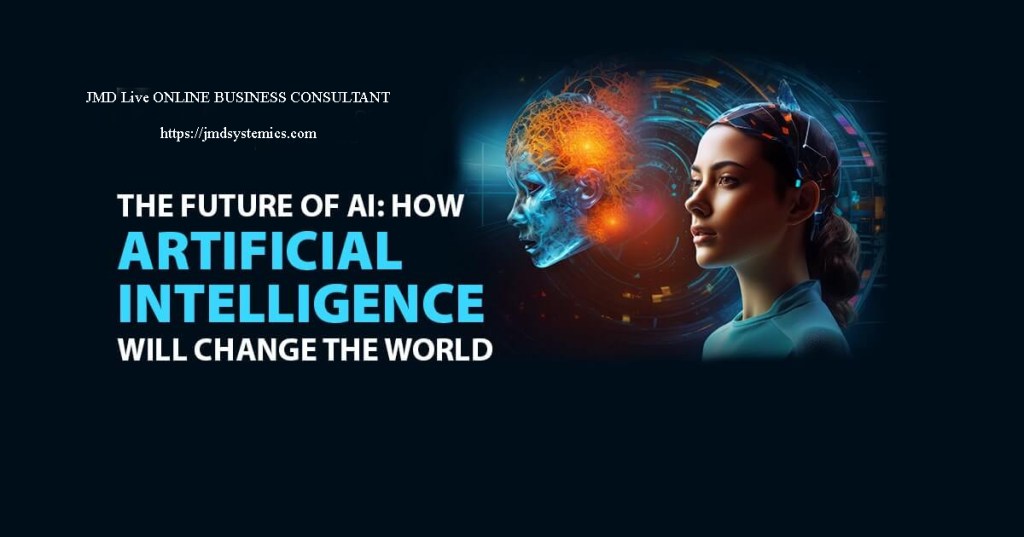
From Tools to Partners, The Future of Artificial Intelligence

11 Wednesday Feb 2026

Posted by JMD Live Online Business Consulting in General

≈ Leave a comment

Tags

ai, Artificial Intelligence, chatgpt, Philosophy, Technology

Artificial Intelligence is no longer a speculative technology on the horizon: it is an operational reality reshaping economies, institutions, and human work. While most discussions about AI focus narrowly on tools, models, or short-term productivity gains, the true future of AI is broader and more consequential: AI is evolving from a passive instrument into an active cognitive partner embedded across society. Understanding this transition is essential for leaders, professionals, and policymakers who want to remain relevant in an AI-driven world.

1. From Narrow Automation to Generalized Intelligence

Early AI systems were designed to perform narrowly defined tasks, recognizing images, translating text, or optimizing logistics. The next phase is characterized by generalized capability, systems that can reason across domains, adapt to new contexts, and collaborate with humans in complex problem-solving.

Key shifts include: Multimodal intelligence (text, image, audio, video, and action); Persistent memory and long-term context; Autonomous goal decomposition and planning; Self-improvement through feedback loops. This does not imply human-level consciousness, but it does mean human-comparable competence across many cognitive tasks.

2. AI as a Cognitive Infrastructure

AI is becoming a foundational layer, similar to electricity or the internet, rather than a standalone product. In the future, AI will be: Embedded invisibly in workflows; Integrated into decision-making systems; Continuously adaptive to users and environments. Organizations will not ask “Should we use AI?” but rather “How is intelligence flowing through our systems?” Competitive advantage will come from orchestrating intelligence, not merely adopting tools.

3. The Transformation of Work and Expertise

In the coming years, AI will not simply eliminate jobs; it will redefine expertise. Routine cognitive labor will be increasingly automated, while human value will concentrate in areas where: Judgment under uncertainty matters; Ethical, social, and contextual reasoning is required; Creativity and strategic synthesis are essential; Accountability and trust are critical.

The most valuable professionals will be those who can: Think systemically; Ask high-quality questions; Supervise and align AI systems; Translate between technical, business, and human domains. In short, the future belongs to AI-augmented professionals, not AI-replaced ones.

4. Governance, Trust, and Alignment

As AI systems gain autonomy and scale, governance becomes a central challenge. The future of AI will be shaped as much by policy and ethics as by technology. Critical issues include: Model transparency and explainability; Bias, fairness, and representational harm; Data ownership and privacy; Accountability for AI-driven decisions; Alignment with human values and societal goals.

Nations and organizations that establish trustworthy AI frameworks will gain long-term legitimacy and public acceptance.

5. The Rise of Personal and Collective AI

We are moving toward a world where individuals have persistent personal AI agents, teams collaborate with shared AI copilots and organizations operate with collective intelligence systems.

These systems will learn individual preferences and goals, act as cognitive extensions of the user and coordinate knowledge across groups at scale. This represents a fundamental shift in how humans think, learn, and collaborate.

6. Risks, Limits, and Reality Checks

Despite rapid progress, AI is not magic. The future will include technical limitations and failures, over-reliance and skill atrophy, concentration of power among a few actors and misuse in surveillance, manipulation, and conflict.

Responsible progress requires clear-eyed realism, not blind optimism or reflexive fear.

Choosing the Future of AI

The future of AI is not predetermined. It will be shaped by how organizations deploy it, how governments regulate it, how professionals adapt to it and how society defines acceptable use.

AI’s ultimate impact will depend less on what the technology can do, and more on what we choose to do with it. Those who engage early, thoughtfully, ethically, and strategically, will help define an AI-enabled future that amplifies human potential rather than diminishes it.

J. Michael Dennis ll.l., ll.m.

Based in Kingston, Ontario, Canada, J. Michael Dennis is a former barrister and solicitor, a Crisis & Reputation Management Expert, a Public Affairs & Corporate Communications Specialist, a Warrior for Common Sense and Free Speech. Today, J. Michael Dennis help executives and professionals understand, evaluate, and responsibly deploy AI without hype, technical overload, or strategic blindness.
Contact

jmdlive@jmichaeldennis.live

Share this:

  • Share on X (Opens in new window) X
  • Share on Facebook (Opens in new window) Facebook
Like Loading...

The Future of AI: A Consultant’s Perspective

11 Wednesday Feb 2026

Posted by JMD Live Online Business Consulting in General

≈ Leave a comment

Tags

ai, Artificial Intelligence, Business, chatgpt, Technology

A Consultant’s Perspective on What Actually Matters

As an AI Consultant, I spend far less time discussing models, benchmarks, or product launches than most people expect. Those details matter, but they are not where the real transformation is happening.

The future of Artificial Intelligence will not be decided by algorithms alone. It will be decided by how organizations, leaders, and institutions choose to integrate intelligence into their decision-making, operations, and culture.

From the field, the signal is clear: AI is moving from a tool you “use” to a system you work with.

1. AI Is Becoming Strategic Infrastructure, Not Software

Most organizations still approach AI as a technology purchase. That mindset is already obsolete. AI is rapidly becoming cognitive infrastructure, a layer that influences: How decisions are made; How work is coordinated; How knowledge flows across the organization; How risks are identified and mitigated.

In the near future, competitive advantage will not come from having access to AI (everyone will), but from how intelligently it is embedded into business processes and governance structures.

This is not an IT problem. It is a leadership problem.

2. The Real Shift: From Automation to Augmentation

The dominant narrative focuses on job displacement. In practice, what I observe is something subtler and more disruptive: the redefinition of expertise.

AI excels at: Pattern recognition; Synthesis at scale; Speed and consistency. Humans remain essential for: Judgment under uncertainty; Contextual and ethical reasoning; Strategic prioritization; Accountability.

The future belongs to professionals who can collaborate with AI systems, supervise them, and translate their outputs into real-world decisions. Organizations that fail to reskill their people around this reality will fall behind, regardless of how advanced their tools appear.

3. Why Most AI Initiatives Fail

From a consulting standpoint, AI failures rarely stem from weak models. They stem from: Poor problem definition; Misaligned incentives; Lack of data governance; Absence of ownership and accountability; Unrealistic expectations driven by hype.

Successful AI adoption requires discipline: Clear use cases tied to measurable outcomes; Human-in-the-loop design; Change management, not just deployment; Continuous evaluation and iteration.

AI is not a one-time implementation. It is an ongoing organizational capability.

4. Trust, Governance, and the Consultant’s Blind Spot

As AI systems gain autonomy, trust becomes the limiting factor.

Leaders increasingly ask: “Can we explain this decision?”; “Who is accountable if this goes wrong?”; “Are we exposing ourselves to legal or reputational risk?”

The future of AI will be constrained, and/or enabled, by governance. Consultants and leaders who ignore this dimension are setting their organizations up for long-term failure.

Responsible AI is not a moral luxury; it is a strategic necessity.

5. The Rise of Personal and Organizational AI Agents

We are entering a phase where AI will be persistent, personalized, and proactive.

In practical terms: Executives will work with AI advisors; Teams will share AI copilots; Organizations will develop collective intelligence systems.

The consultant’s role will evolve accordingly: from recommending tools to architecting intelligence ecosystems aligned with strategy, culture, and values.

6. What Leaders Should Be Doing Now

From my perspective, the organizations that will thrive are already: Treating AI as a board-level topic; Investing in AI literacy across leadership; Designing governance before scaling deployment; Experimenting in controlled, high-impact areas; Focusing on augmentation, not replacement.

Waiting for “mature” AI is a strategic error. Maturity comes from engagement.

Conclusion: AI Will Reward Clarity, Not Hype

The future of AI will not favor the loudest adopters or the most aggressive automators. It will favor those who approach AI with clarity of purpose, discipline of execution, and respect for human judgment.

As an AI Consultant, my role is not to sell technology, it is to help organizations think clearly about intelligence: how it is created, governed, and applied. Those who do this well will not just survive the AI transition. They will shape it.

J. Michael Dennis ll.l., ll.m.

Based in Kingston, Ontario, Canada, J. Michael Dennis is a former barrister and solicitor, a Crisis & Reputation Management Expert, a Public Affairs & Corporate Communications Specialist, a Warrior for Common Sense and Free Speech. Today, J. Michael Dennis help executives and professionals understand, evaluate, and responsibly deploy AI without hype, technical overload, or strategic blindness.

Contact

jmdlive@jmichaeldennis.live

Share this:

  • Share on X (Opens in new window) X
  • Share on Facebook (Opens in new window) Facebook
Like Loading...

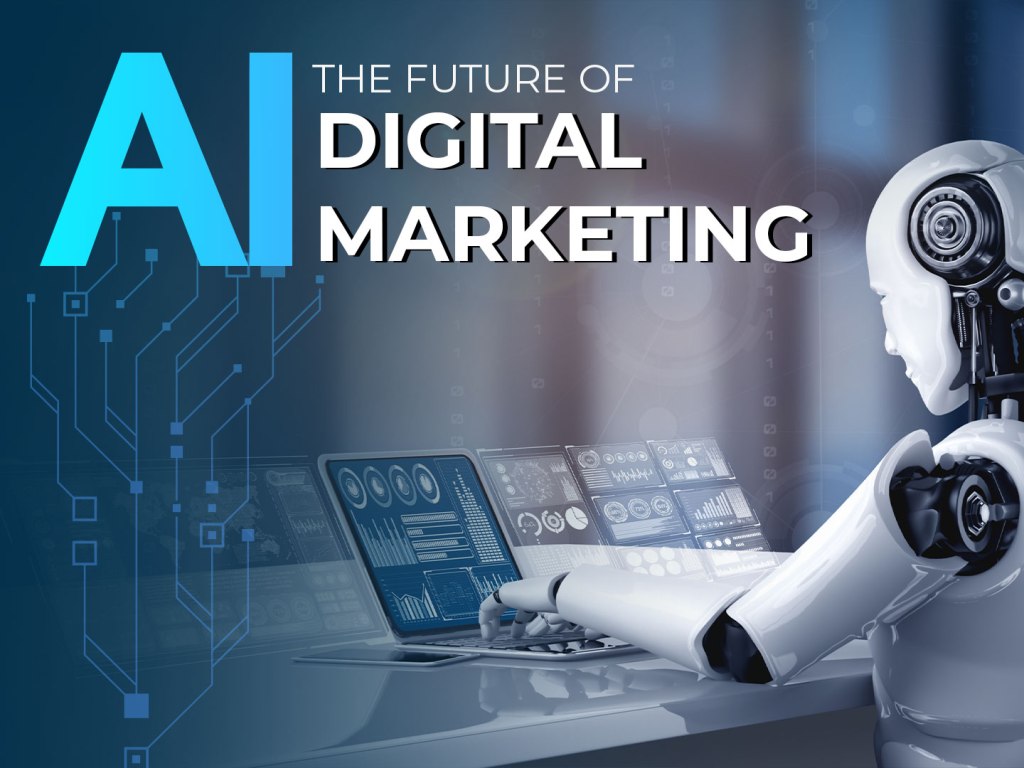
The Future of Artificial Intelligence & Digital Marketing

03 Wednesday Apr 2024

Posted by JMD Live Online Business Consulting in General

≈ Leave a comment

Tags

ai, Artificial Intelligence, digital-marketing, Marketing, Technology

Generative AI has been seen by some as a sort of magical tool that is able to create unique images, voices, and videos with minimal effort. But it has been extremely controversial for creative professionals. In these early days of the technology, some less-than-honest creators have been using it as a quick shortcut that used AI-generated imagery. AI-generated images often appear high quality at first glance, but contain inconsistencies in areas including hands, fingers, or background details. Once your eye is trained to spot these flaws, they cannot be unseen.

AI can be very positive or very negative, very constructive, or very destructive. AI is a Language Learning Machine [LLM]. Feed it with falsehoods and immoral or illegal information, you will end up with a vey evil machine. Feed it with wisdom and absolute truth, you will end up with a very helpful, powerful, and constructive assistant.

I created my own AI assistant, a clone of myself fed with wisdom, veracity, and exactness. Here is how to get started in using AI to look at data and engagement, helping harness creative marketing potential.

In the face of macro headwinds, many marketing teams have shifted their focus towards efficiency and return on investment (ROI), inadvertently relegating creativity to the backseat. This efficiency-driven approach, while necessary, often results in marketers spending a significant amount of time on routine tasks, leaving less room for creative experimentation. On top of that, marketers may lack the knowledge or access to innovative tools and technologies that can foster creativity. This dynamic presents a unique challenge for marketing teams striving to balance efficiency with creative innovation.

Artificial Intelligence (AI) presents a promising solution to this productivity paradox. Furthermore, AI can provide a canvas for experimentation, sparking creativity by offering new ways to engage audiences and personalize content. And many marketers seem eager to embrace these opportunities. Marketers clearly recognize the potential, but the reality is many marketers and consumers are still learning about AI, including how to put it into practice. The complexity of AI technologies coupled with a lack of knowledge about how to effectively use them can be a major barrier to reaping its benefits. Overcoming these obstacles is crucial for marketers to fully harness the potential of AI in fostering creativity while maintaining efficiency.

So, what can marketing leaders do to set their teams up in 2024 for success?

A staggering 98% of surveyed marketers identified issues holding them back from being creative and strategic. The obstacles are not singular, but rather a combination of four parallel challenges, and the focus areas are not all too surprising. These include an overemphasis on KPIs that stifles creativity, too much time spent on routine tasks, a lack of technology to execute creative ideas, and difficulty demonstrating the ROI of creativity. Helping marketing teams execute faster and more effectively is a powerful first step to help them move past these challenges and get back to the work they’re passionate about.

AI’s Role in Achieving Data Agility and Higher Productivity

With more time for strategic work, marketers can tackle challenges associated with breaking down silos across teams to leverage data more effectively and drive business outcomes. Despite the vast amounts of data generated daily, only 24% of brands are currently mapping customer behavior and sentiment, and a mere 6% are applying customer insights to their product and brand approach.

This underutilization of data is a missed opportunity, especially considering AI’s capacity to process, analyze, and draw meaningful insights from complex data sets, enabling it to predict customer behavior, preferences, and trends. AI can be the bridge that by enabling businesses to make informed strategic decisions that significantly impact the customer experience.

By leveraging AI and breaking down silos between teams, brands can achieve higher productivity to gain a competitive and creative edge. As businesses move beyond vanity metrics and aim to deepen first-party relationships with customers, it is crucial that they can quickly act on data to create personalized experiences in-the-moment and at scale. And doing this can really pay off.

Marketers Need Cross-Functional Allies

For teams to be strategic, creative, and maximize their data usage for customer engagement they need to work more cross-functionally. Unlocking the full potential of AI necessitates a deeper collaboration with teams responsible for data management, including those handling data warehouses, business intelligence applications, CRMs, and other data-rich platforms. The siloed approach of the past is no longer effective in a world where customer touchpoints require stronger alignment and partnership between teams that manage data to power experiences across various channels. This type of collaboration requires a shift in mindset, breaking down departmental barriers, and encouraging open communication, especially as execution moves faster with AI.

At JMD Live ONLINE BUSINESS CONSULTING, we use AI not only to help our customers craft creative, personalized experiences, but we also experiment with AI in our own marketing to save valuable time and resources in customer engagement, while increasing our strategic cross-functional collaboration and creativity in social and digital engagement.

AI is a transformative force that is reshaping marketing. The challenges marketers face today, from the pressure to deliver ROI, the time-consuming routine tasks, to the underutilization of data, are not insurmountable. However, the journey to fully realize the benefits of AI requires not just the adoption of technology, but also a shift in mindset, a commitment to continuous learning, and a culture of cross-functional collaboration. Only then can we fully unlock the creative potential of AI.

Michel Ouellette JMD, ll.l., ll.m.

JMD Live Online Subscription link

J. Michael Dennis, ll.l., ll.m.

Business & Corporate Strategist

Systemic Strategic Planning

Quality Assurance, Occupational Health & Safety, Environmental Protection, Regulatory Compliance, Crisis & Reputation Management

Skype: jmdlive

Email: jmdlive@jmichaeldennis.live

Web: https://www.jmichaeldennis.live

Phone: 24/7 Emergency Access

Available to our clients/business partners

Share this:

  • Share on X (Opens in new window) X
  • Share on Facebook (Opens in new window) Facebook
Like Loading...

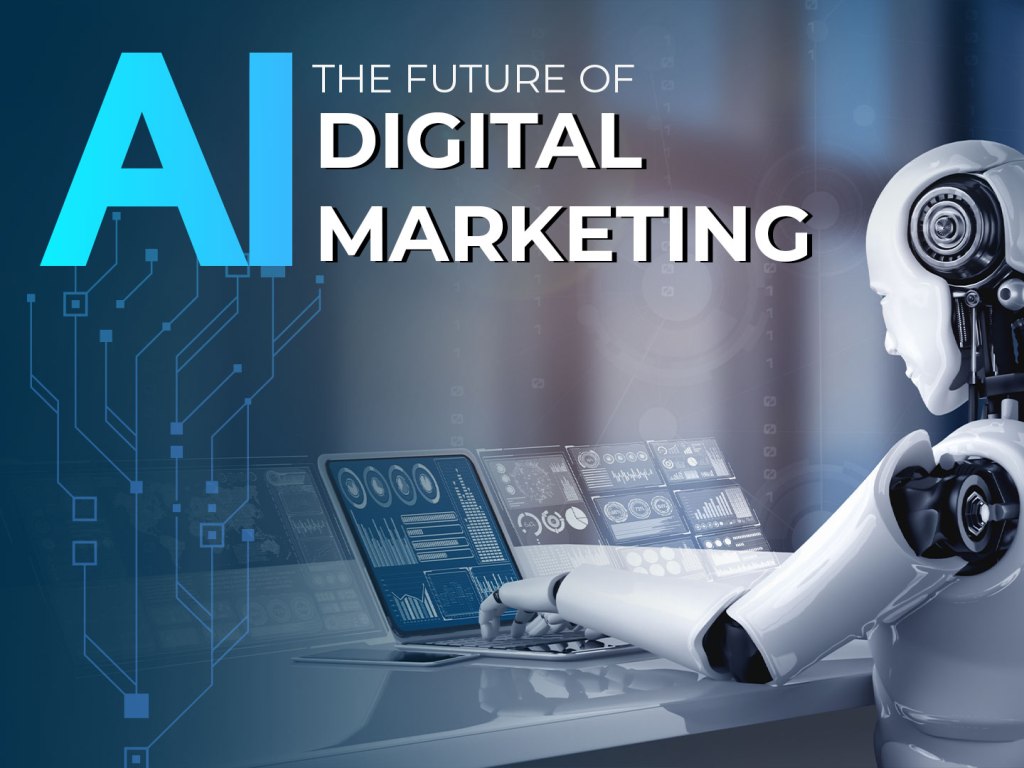
The Future of Artificial Intelligence & Digital Marketing

03 Wednesday Apr 2024

Posted by JMD Live Online Business Consulting in Artificial Intelligence

≈ Leave a comment

Tags

ai, Artificial Intelligence, digital-marketing, Marketing, Technology

Generative AI has been seen by some as a sort of magical tool that is able to create unique images, voices, and videos with minimal effort. But it has been extremely controversial for creative professionals. In these early days of the technology, some less-than-honest creators have been using it as a quick shortcut that used AI-generated imagery. AI-generated images often appear high quality at first glance, but contain inconsistencies in areas including hands, fingers, or background details. Once your eye is trained to spot these flaws, they cannot be unseen.

AI can be very positive or very negative, very constructive, or very destructive. AI is a Language Learning Machine [LLM]. Feed it with falsehoods and immoral or illegal information, you will end up with a vey evil machine. Feed it with wisdom and absolute truth, you will end up with a very helpful, powerful, and constructive assistant.

I created my own AI assistant, a clone of myself fed with wisdom, veracity, and exactness. Here is how to get started in using AI to look at data and engagement, helping harness creative marketing potential.

In the face of macro headwinds, many marketing teams have shifted their focus towards efficiency and return on investment (ROI), inadvertently relegating creativity to the backseat. This efficiency-driven approach, while necessary, often results in marketers spending a significant amount of time on routine tasks, leaving less room for creative experimentation. On top of that, marketers may lack the knowledge or access to innovative tools and technologies that can foster creativity. This dynamic presents a unique challenge for marketing teams striving to balance efficiency with creative innovation.

Artificial Intelligence (AI) presents a promising solution to this productivity paradox. Furthermore, AI can provide a canvas for experimentation, sparking creativity by offering new ways to engage audiences and personalize content. And many marketers seem eager to embrace these opportunities. Marketers clearly recognize the potential, but the reality is many marketers and consumers are still learning about AI, including how to put it into practice. The complexity of AI technologies coupled with a lack of knowledge about how to effectively use them can be a major barrier to reaping its benefits. Overcoming these obstacles is crucial for marketers to fully harness the potential of AI in fostering creativity while maintaining efficiency.

So, what can marketing leaders do to set their teams up in 2024 for success?

A staggering 98% of surveyed marketers identified issues holding them back from being creative and strategic. The obstacles are not singular, but rather a combination of four parallel challenges, and the focus areas are not all too surprising. These include an overemphasis on KPIs that stifles creativity, too much time spent on routine tasks, a lack of technology to execute creative ideas, and difficulty demonstrating the ROI of creativity. Helping marketing teams execute faster and more effectively is a powerful first step to help them move past these challenges and get back to the work they’re passionate about.

AI’s Role in Achieving Data Agility and Higher Productivity

With more time for strategic work, marketers can tackle challenges associated with breaking down silos across teams to leverage data more effectively and drive business outcomes. Despite the vast amounts of data generated daily, only 24% of brands are currently mapping customer behavior and sentiment, and a mere 6% are applying customer insights to their product and brand approach.

This underutilization of data is a missed opportunity, especially considering AI’s capacity to process, analyze, and draw meaningful insights from complex data sets, enabling it to predict customer behavior, preferences, and trends. AI can be the bridge that by enabling businesses to make informed strategic decisions that significantly impact the customer experience.

By leveraging AI and breaking down silos between teams, brands can achieve higher productivity to gain a competitive and creative edge. As businesses move beyond vanity metrics and aim to deepen first-party relationships with customers, it is crucial that they can quickly act on data to create personalized experiences in-the-moment and at scale. And doing this can really pay off.

Marketers Need Cross-Functional Allies

For teams to be strategic, creative, and maximize their data usage for customer engagement they need to work more cross-functionally. Unlocking the full potential of AI necessitates a deeper collaboration with teams responsible for data management, including those handling data warehouses, business intelligence applications, CRMs, and other data-rich platforms. The siloed approach of the past is no longer effective in a world where customer touchpoints require stronger alignment and partnership between teams that manage data to power experiences across various channels. This type of collaboration requires a shift in mindset, breaking down departmental barriers, and encouraging open communication, especially as execution moves faster with AI.

At JMD Live ONLINE BUSINESS CONSULTING, we use AI not only to help our customers craft creative, personalized experiences, but we also experiment with AI in our own marketing to save valuable time and resources in customer engagement, while increasing our strategic cross-functional collaboration and creativity in social and digital engagement.

AI is a transformative force that is reshaping marketing. The challenges marketers face today, from the pressure to deliver ROI, the time-consuming routine tasks, to the underutilization of data, are not insurmountable. However, the journey to fully realize the benefits of AI requires not just the adoption of technology, but also a shift in mindset, a commitment to continuous learning, and a culture of cross-functional collaboration. Only then can we fully unlock the creative potential of AI.

Michel Ouellette JMD, ll.l., ll.m.

JMD Live Online Subscription link

J. Michael Dennis, ll.l., ll.m.

Business & Corporate Strategist

Systemic Strategic Planning

Quality Assurance, Occupational Health & Safety, Environmental Protection, Regulatory Compliance, Crisis & Reputation Management

Skype: jmdlive

Email: jmdlive@jmichaeldennis.live

Web: https://www.jmichaeldennis.live

Phone: 24/7 Emergency Access Available to our clients/business partners

Share this:

  • Share on X (Opens in new window) X
  • Share on Facebook (Opens in new window) Facebook
Like Loading...

Embracing AI

02 Tuesday Apr 2024

Posted by JMD Live Online Business Consulting in General

≈ Leave a comment

Tags

ai, Artificial Intelligence, chatgpt, machine-learning, Technology

“You may not know what is coming down the pike, the article posited, but if you are wearing the right clothes and sporting the right hairstyle when the acquiring company shows up, you could stand out and survive.”

The fact is, despite the fear and hype, generative AI remains an enigma.

A recent study reveals that 63% of leaders feel that AI must play a significant role in their business but 91% do not yet know how. At the same time, there is a palpable sense of urgency: over half of C-suite executives believe that their business will be dead by 2030 if they do not embrace AI. Uncertainty and speed are scary bedfellows: 79% of my readers and followers do not trust corporations to make responsible choices about implementing AI.

Most experts believe that AI will support, not replace, human performance. But people who use AI will likely replace those who do not. You have a choice. You can ignore AI until you have a better sense of how it will affect your life. Or you can be proactive. There has never been a better time to lean on your growth mindset, to become an avid student of this vast and fast technology. Here are five ways to build the skills you need to survive.

Get Ahead Of The Learning Curve

The jargon around AI is like a new language. Start by learning as much as you can. Knowledge is power, and with a little work, you can flex yours.

Beyond just learning how AI works, explore where it works or does not. AI has promise, but it is not without pitfalls. For example, many companies are using hiring algorithms to surface talent and missing good people because their algorithms are too narrow and are inundated with resume when their algorithms are too broad. Understand how companies are using AI well and where they are stumbling.

Explore the philosophical and moral quandaries that underlie AI’s potential for good and bad. Embracing the rabbit hole means exploring at every turn. It is amazing how proficient you can become when you let your curiosity take the reins.

Experiment A Lot

Adopting an experimental mindset is the best way to gain in-the-trenches experience. Start with a non-proprietary work project. Feed it to a large language model like ChatGPT and ask it what it would add. Prompt it to rephrase your work or to recast it for someone without expertise. Because you are experimenting in a field you already know, you will quickly gauge the value of its inputs. It will also encourage you to see your own work from different angles.

Experimenting with this technology does not have to mean more work. You can play with AI, write your memoir in the style of your favorite author, animate your doodles or your children’s artwork, use AI to turn a still picture into an avatar that talks to you, chat with historical figures. The AI-driven experimental possibilities are endless.

Do not Accept AI At Face Value

Large language models, with their very human-like communications, can feel misleadingly when they produce data-rich answers in record time. But they can hallucinate, make up responses where their training data is lacking based on plausible but incorrect logic. And AI algorithms have been known to rely on shortcut learning, causing false correlations, amplifying discrimination, and producing unreliable results. Do not accept AI’s outputs at face value. Challenge assumptions and triangulate with other research.

In my first foray with AI, I sought research-based insights, together with the relevant sources. Impressed by the outcomes, I looked up the sources, only to find that the authors and the journals were real, but the papers did not exist. Treat AI like a first-year intern: “Eager To Please But Far From Perfect”.

Get Really Good At Asking Questions

New technologies cultivate new jobs. And AI is proving to be fertile soil. The World Economic Forum named prompt engineering, “the art and science of asking the right questions”, the #1 job of the future in 2023. Asking good questions helps you learn from diverse perspectives. Engaging with algorithms is no exception: better questions give you more outputs to explore a wider array of possibilities and find better solutions.

The most effective human questions are open-ended, curious, and personal. But when it comes to a Large Language Model [LLM], clarity is king. Frame the context of the inquiry and the perspective you want the LLM to take, a specific point of view, a particular profession, or an identity to assume. Provide context: what you need and what you want to do with it, examples, process steps and even desired references. Finally, spell out the output, including format and style. The art of good prompts allows AI to handle the rote retrieval of technical information, freeing humans to access and curate a wealth of knowledge, and to combine and rapidly test new ideas in even the most technically complex contexts. Done well, it is a powerful man-machine partnership.

Do not Go It Alone

In the zeal to adapt, do not forsake the superpower that makes humans more effective than any machine: our ability to work and thrive in community.

Throughout history, humans have leveraged their collective strength to make sense of thorny challenges and new threats. Working with others helps you experiment broadly, debate ethical implications, and share results to learn faster. And collaboration neutralizes the anxiety that comes with impending existential change. Widening the group of AI learners in your organization helps you to be part of crafting the strategy instead of waiting to see where the chips fall. Build a broadly diverse learning community to garner the best and most varied ideas. Your collective wisdom will make you and your colleagues indispensable to your organization’s AI future.

Thankfully, you do not need a makeover to weather the AI storm. But your mindset probably does. This is not the time to take a wait-and-see approach. Even if it is hard to imagine how generative AI will affect your job right now, the train is already barreling down the tracks. To stand out from the crowd and be ready for what comes, get ready now. A deeper understanding of AI and its trajectories is one of the most effective job skills you can develop for today and tomorrow. The only thing we know for sure is that AI will fundamentally change the world of work. Instead of waiting for the road to clear, forge the path.

Michel Ouellette JMD, ll.l., ll.m.

JMD Live Online Subscription link

J. Michael Dennis, ll.l., ll.m.

Business & Corporate Strategist

Systemic Strategic Planning

Quality Assurance, Occupational Health & Safety, Environmental Protection, Regulatory Compliance, Crisis & Reputation Management

Skype: jmdlive

Email: jmdlive@jmichaeldennis.live

Web: https://www.jmichaeldennis.live

Phone: 24/7 Emergency Access

Available to our clients/business partners

Share this:

  • Share on X (Opens in new window) X
  • Share on Facebook (Opens in new window) Facebook
Like Loading...
← Older posts

Subscribe

  • Entries (RSS)
  • Comments (RSS)

Archives

  • March 2026
  • February 2026
  • April 2024
  • March 2024
  • February 2024
  • January 2024
  • December 2023
  • November 2023
  • October 2023
  • July 2023
  • June 2023
  • May 2023
  • July 2021
  • April 2021
  • March 2021
  • February 2021
  • January 2021
  • November 2020
  • September 2020
  • August 2020
  • July 2020
  • June 2020
  • May 2020
  • April 2020
  • March 2020
  • February 2020
  • January 2020
  • October 2019
  • September 2019
  • August 2019
  • July 2019
  • June 2019
  • May 2019
  • April 2019
  • December 2018
  • October 2018
  • September 2018
  • June 2018
  • May 2018
  • March 2018
  • February 2018
  • January 2018
  • December 2017
  • November 2017
  • October 2017
  • September 2017
  • August 2017
  • July 2017
  • June 2017
  • February 2017
  • January 2017
  • December 2016
  • September 2016
  • August 2016
  • July 2016
  • June 2016
  • May 2016
  • April 2016
  • March 2016
  • February 2016
  • December 2015
  • September 2015
  • August 2015
  • February 2015
  • December 2014
  • September 2014
  • June 2014
  • May 2014
  • April 2014
  • February 2014
  • January 2014
  • December 2013
  • October 2013
  • September 2013
  • June 2013
  • May 2013
  • April 2013
  • March 2013
  • February 2013
  • January 2013
  • December 2012
  • November 2012
  • October 2012
  • September 2012
  • August 2012
  • July 2012
  • June 2012
  • May 2012
  • March 2012
  • February 2012
  • January 2012

Categories

  • AI News
  • Artificial Intelligence
  • Corporate and Regulatory Compliance
  • Crisis & Reputation Management
  • General
  • Online Consulting
  • Public Affairs and Communications
  • Systemic Strategic Planning
  • The Future of AI

Meta

  • Create account
  • Log in
Follow J. Michael Dennis ll.l., ll.m. Live on WordPress.com

Enter your email address to follow this blog and receive notifications of new posts by email.

Blog at WordPress.com.

  • Subscribe Subscribed
    • J. Michael Dennis ll.l., ll.m. Live
    • Join 41 other subscribers
    • Already have a WordPress.com account? Log in now.
    • J. Michael Dennis ll.l., ll.m. Live
    • Subscribe Subscribed
    • Sign up
    • Log in
    • Report this content
    • View site in Reader
    • Manage subscriptions
    • Collapse this bar
 

Loading Comments...
 

You must be logged in to post a comment.

    %d